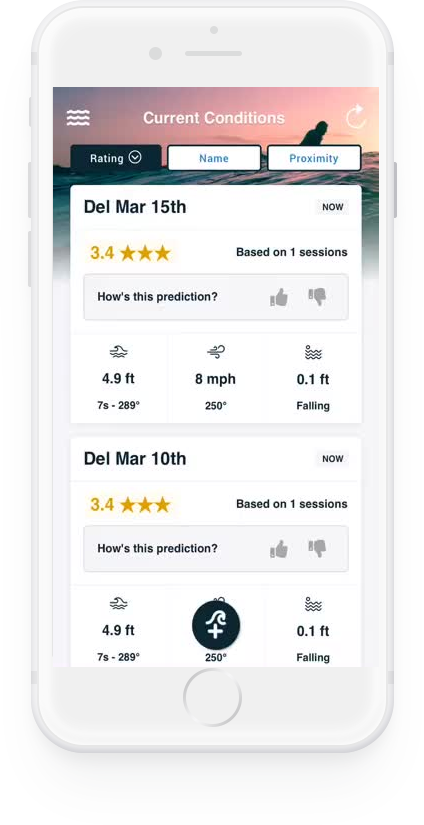

Here's what LazySurfer does in one paragraph: after you log a handful of surf sessions with ratings, LazySurfer's prediction service runs a custom PyTorch deep neural network — retrained every week on real logged sessions from the LazySurfer community, with a per-user embedding that learns your specific preferences — to predict the rating you'd give any current or forecast reading at your favorite spots. Validation accuracy is 90.3% exact-match, 97.6% within one star. The more sessions you log, the sharper your personal predictions get. When the forecast matches a session you loved, LazySurfer sends a push notification so you don't miss the window.
Read the detailed explainer on the how it works page, or jump to the FAQ.
LazySurfer pulls real NOAA ocean-buoy data and feeds it into a custom deep-learning model. The model predicts your 5-star rating at 90% accuracy and retrains every week on real surfer sessions, so it gets sharper over time. The six core features below power session logging, current-conditions matching, the extended forecast, and push alerts when your favorite spots are firing.
Lazy Surfer retrieves wind, wave, and tide information with the click of a button.
Wind, wave, and tide data is from NOAA ocean buoys.
Get alerted when your favorite spots are pumping - never miss a good session again.
Lazy Surfer lets you add or edit sessions up to 45 days in the past.
Know when your spots are going to be good early so you can plan your sessions. The free tier covers the next 48 hours.
Save your sessions to the cloud for backup or download for data analysis.
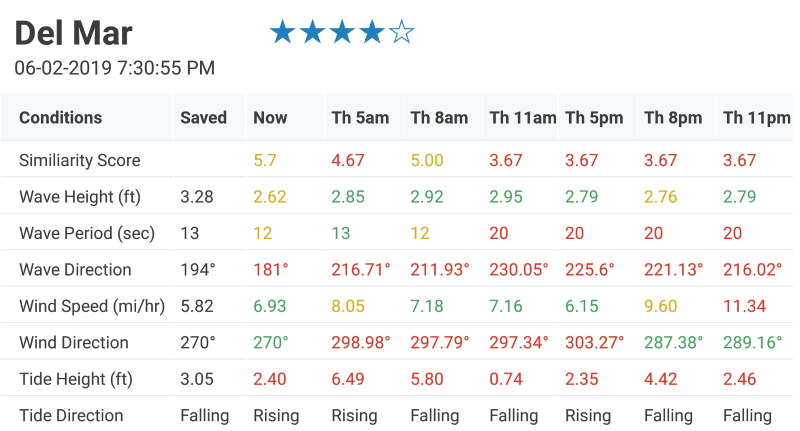
The key to Lazy Surfer is the Similarity Score - this describes how close the current or future conditions are to the conditions you've saved. When the score is close to ten then the conditions should be similar. When it's close to zero, the conditions are very different.
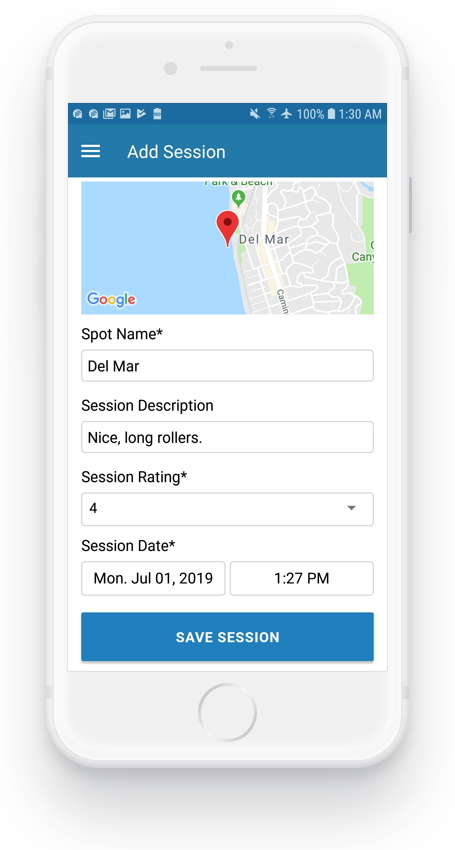
After each session fill in the spot name, a description and a rating.
Lazy Surfer will retrieve and save condition information from the closest wind, wave, and tide buoys.
Use the Similarity Score to find the best time and place to surf.
Download Lazy Surfer today - we guarantee that it'll help you find better waves.
 Apple Store
 Play Store
Honest head-to-head comparisons against every surf forecast app worth considering. If you're shopping around, read our pick for the best surf forecast app of 2026, or start with the best free Surfline alternatives or our roundup of the best free surf forecasting apps for 2026 — then pick the one that fits your spot, your phone, and your wallet.